- Category:
Small Business Energy Savings -
Last updated:
October 28, 2026
How to Reduce Holiday Energy Waste at Your Business
By making a few changes as you put up decorations and extend your business operations, you can still celebrate the holidays while saving energy. More lighting, heating, employees and customers don’t have to mean spiraling energy costs. And if your business slows over the holidays, you don’t have to run your operations at full power. Here, we’ll discuss how to save energy during extended business hours over the holidays.
Why your standard business schedule may waste energy during the holidays
Many businesses change their operating hours over the holidays. For some, that means extending hours, adding events, using extra lighting and power for displays and placing a greater demand on HVAC systems. For others, it can mean early closures, extra days off or total shutdowns, along with reduced staff and managing energy usage in spaces that aren’t in full use. If you stick to your usual business schedule, you may end up paying for electricity usage you don’t need.
How to match your energy use to your holiday schedule
Matching energy use to your holiday schedule helps you adjust lighting, heating, cooling and equipment operation to meet actual demand. Whether your business scales back its hours or ramps up for seasonal activities, thoughtful changes can help reduce energy waste and control costs without disrupting operations.
Before the holidays: Set your energy schedule
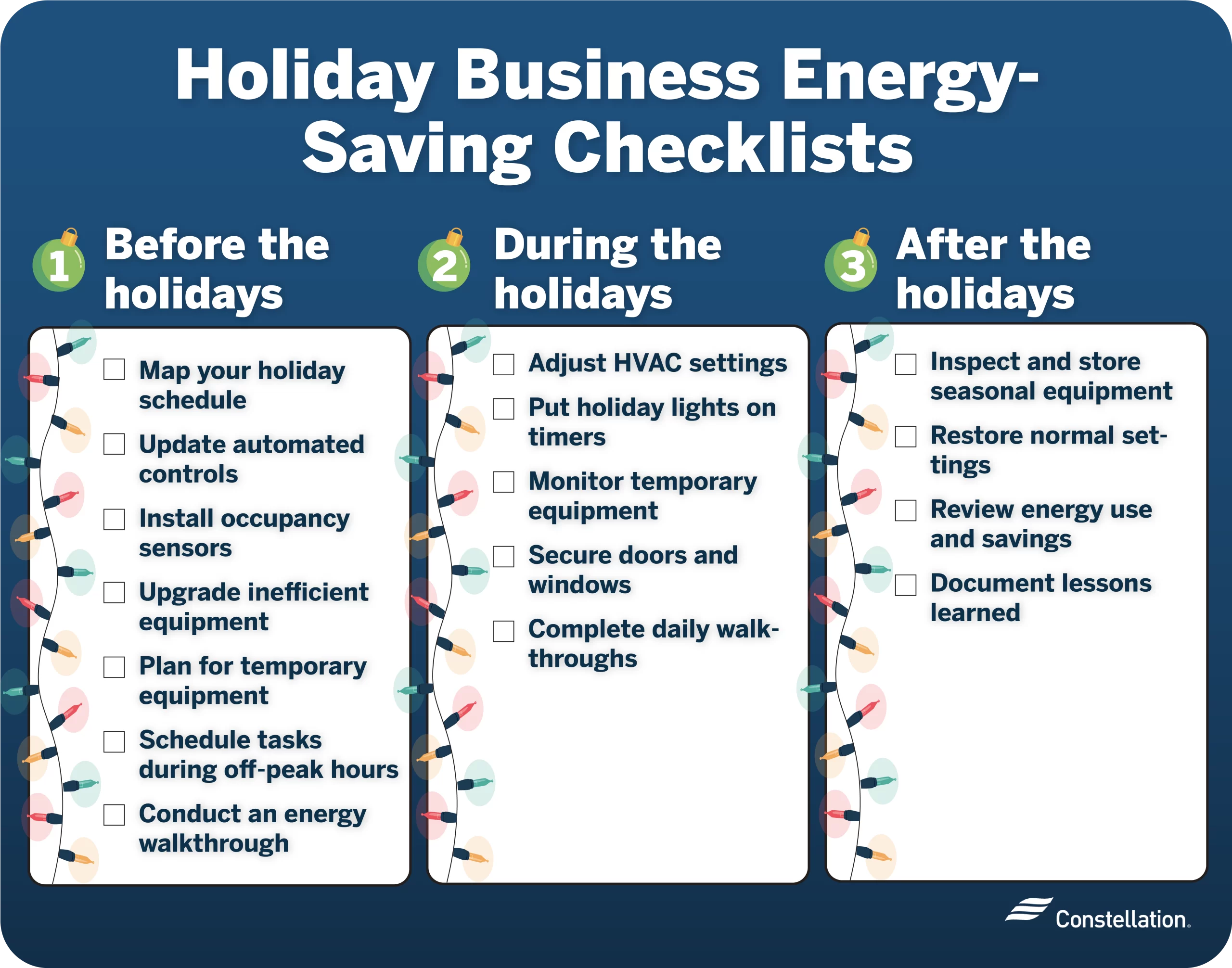
Plan now to prepare your business for the coming holidays. Taking time to review your schedule, operating needs and power requirements before the holiday rush gives you time to make decisions about managing energy usage. Here’s a checklist of the key steps to take for holiday energy use management:
- Map your calendar: Lay out your schedule for operating hours, such as when you expect deliveries, when you’ll hold any special events and what days you’ll be closed. Plan what areas of your facility you’ll use and the energy requirements for setup and cleanup.
- Update controls: Automate controls such as lights, thermostats and equipment according to a pre-planned schedule. Assign a staff member to adjust settings as needed and ensure everything is powered off at closing.
- Install occupancy sensors: Many areas of your facility may be used intermittently. Leaving lights on all the time in these spaces wastes energy. Occupancy sensors automate when lights switch on and off in storage rooms, meeting rooms, bathrooms and other places that aren’t continually occupied.
- Upgrade to energy-efficient equipment: Outdated equipment, appliances and lighting are not as energy-efficient as today’s models. Look at your budget and consult with a tax professional to see if upgrading before the end of the year makes sense.
- Plan temporary equipment: If you’re adding holiday displays or temporary equipment to increase capacity, calculate the impact on your energy usage. Review the capacity of your existing HVAC system and look for energy-conscious heating options if you need a short-term boost.
- Plan energy-intensive tasks outside of peak hours: Check if you’re on a time-of-use plan or other program that encourages your business to move energy-intensive tasks to off-peak hours. You may be able to lower your energy bill over the holidays by running laundry overnight or changing shift hours.
- Do a walkthrough: Once you’ve made changes to your energy usage to fit your holiday needs, conduct a formal tour through your facility. Check on lighting, indoor temperatures, equipment usage and automated sensors and settings to make sure everything is running well. Check periodically throughout the holiday season to make updates and changes as needed.
Tasks to do during holidays: Use energy where it’s needed
The holidays disrupt business as usual. For some, it’s the busy season, and for others, operations slow down. Changing your energy usage to match these changes ensures you minimize waste and control utility costs. Here are some practical steps you can take:
- Adjust HVAC: Set your thermostat to match occupancy changes and business hours. Reduce usage in areas you barely use.
- Put decorative lighting on a timer: Set displays and lights to turn on and off automatically according to your holiday schedule. Choose efficient LED lights wherever possible.
- Review temporary equipment use: Make sure to automate temporary devices and extra lighting where possible. Assign someone the task of monitoring this equipment to avoid waste.
- Ensure doors and windows are secured: With increased foot traffic, doors open and close more often. Make sure they’re not propped open, install automatic closers and check for gaps and drafts around windows.
- Do a walkthrough at the end of each day: Before leaving, check for lights or equipment left on. Reset the thermostat for when your spaces aren’t occupied, and confirm that timers and controls are running on the right schedule.
While business is temporarily closed
If your business slows or shuts down over the holidays, you have the potential to significantly cut your energy usage. Here are some tips for saving energy when your business is closed or operations are reduced:
- Lower your thermostat: Set a temperature that safeguards your equipment and infrastructure. In cold climates, set it lower but not so low that pipes freeze. In hot climates, you can set the temperature higher, but leave the air-conditioning running to prevent moisture problems and protect temperature-sensitive equipment.
- Ensure devices are unplugged: Many devices still draw power even when you turn them off. To prevent this energy waste, unplug any electronics and equipment that aren’t in use.
- Consider turning off lights: Keep only the lights you need for safety and security on, and turn all other lights off. Having critical lights at entry points or stairwells on motion sensors ensures you’re only using power when needed.
After the holidays: Reset controls and evaluate results
Once your decorations are put away, temporary equipment is disconnected and your schedule returns to normal, review your energy use. You may discover ways you can improve next year. You may also find temporary holiday energy-saving changes that you can make permanent. Follow these steps to evaluate your energy use and plan for next year:
- Take down and inspect seasonal equipment: Inspect cords, plugs, electrical components of holiday displays and temporary equipment for damage prior to putting them into storage. That way, you can be ready to go without trouble next year.
- Restore normal equipment settings: Reset thermostats, timers, controls and automated systems to match your return to a regular schedule.
- Analyze usage data and savings: Compare your energy usage during the holidays to previous periods and the holiday season from last year. Information on your utility bills may give you insights into where your operations can be more efficient.
- Document lessons learned for next year: Don’t let lessons learned be forgotten. Record the steps you took to save energy and how well they worked. Use your findings to plan for next year’s holiday season.
Minimizing your holiday energy footprint
Reducing energy waste and controlling energy costs over the holidays involves planning ahead and making well-thought-out changes. By matching your energy needs to the demands of your business operations this season, you can eliminate unnecessary energy consumption without compromising on holiday cheer, customer service, comfort or efficiency.