- Category:
Small Business Energy Savings -
Last updated:
February 13, 2026
How to Adapt to Changing Consumer Behavior
Consumer behavior is always changing. That’s why tracking emerging trends and adapting quickly is key to helping your business thrive.
Some customers are struggling with economic uncertainty. Many are trying to navigate quickly evolving technology. They weigh value, trust and personal well-being against convenience and cost. Staying current with today’s consumer behavior outlook can help you identify better ways to serve, deliver value and build loyalty.
This guide looks at consumer spending habits and the biggest consumer trends of 2026. We’ve included practical ways for your business to respond while investing in energy-efficiency and sustainability improvements to keep your operations productive and adaptable.
Consumer behavior is a moving target. Instead of focusing on the challenge, take it as an opportunity to grow and profit.
Why are customer sentiment and spending habits changing?
Consumers are adjusting their spending patterns in response to economic pressures, changes in AI and technology, and growing uncertainty at both the global and local levels. Some of the key factors driving this shift include:
- The potential effects of tariffs remain uncertain.
- Many institutions have lost a significant amount of trust, which affects businesses and brands.
- Online retail continues to put pressure on brick-and-mortar stores.
- AI-assisted shopping is starting to change how consumers gather information and make buying decisions.
Being cautious with purchases, seeking value and focusing on buying the essentials are examples of current consumer behavior. Changing consumer spending habits also point to splurging in some areas while cutting down in others.
What’s changing in consumer trends in 2026?
Consumer trends in 2026 are marked by a mix of caution and greater empowerment. AI technology adds convenience and a wealth of information to the shopping experience. Companies that embrace technology and operational changes to simplify buying, build trust and deliver clear value will come out ahead.
Here are the headlines for the consumer behavior outlook in the coming months.
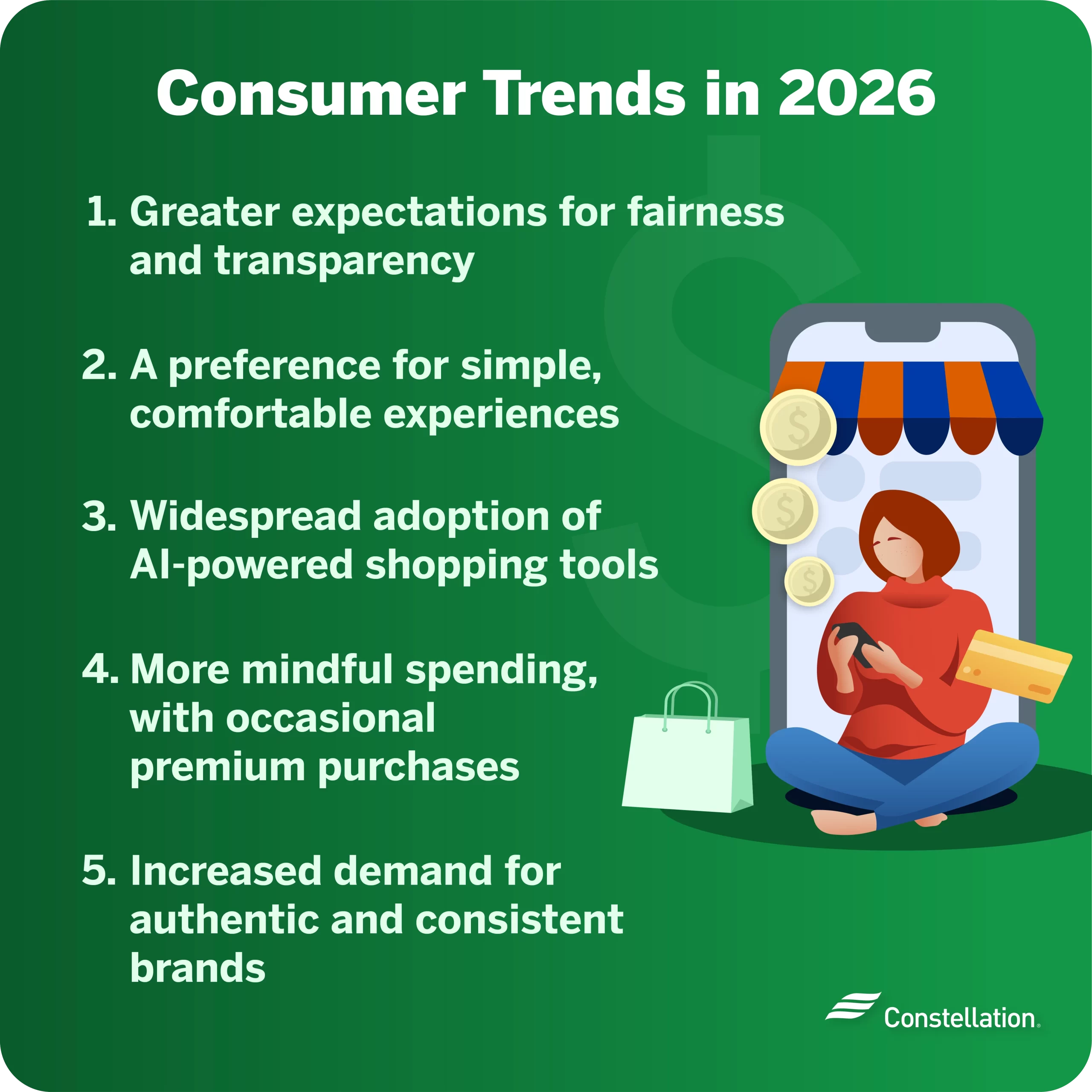
1. More emphasis on fairness and transparency
Consumer behavior today is greatly driven by fairness and transparency. Consumers expect clear, logical pricing, consistent and transparent policies, easy-to-understand warranties and fully disclosed ingredients and processes. Customers want to trust in the companies they buy from and the products they choose.
How to adapt:
- Create a logical pricing structure and disclose the details, avoiding anything that could be considered a hidden fee or unexpected cost.
- Provide detailed ingredient lists and sourcing information, and consider disclosing environmental impacts such as Scope 1 direct emissions from your own operations, Scope 2 emissions from purchased electricity and energy and Scope 3 emissions tied to your broader supply chain, as this will help customers better understand your carbon footprint.
- Instead of merely claiming product quality, explain the details that go into your products, using data-driven storytelling to justify your claims and prices.
2. Customers seek simplicity and comfort
One of the key consumer trends of 2026 is managing complexity and risk in a world that feels volatile and stressful. People are looking for simplicity, predictability and comfort. In a recent study, 58% of respondents reported experiencing moderate to extreme stress every day. As daily routines continue to evolve, people are spending more time at home and increasingly prefer online shopping in many categories.
How to adapt:
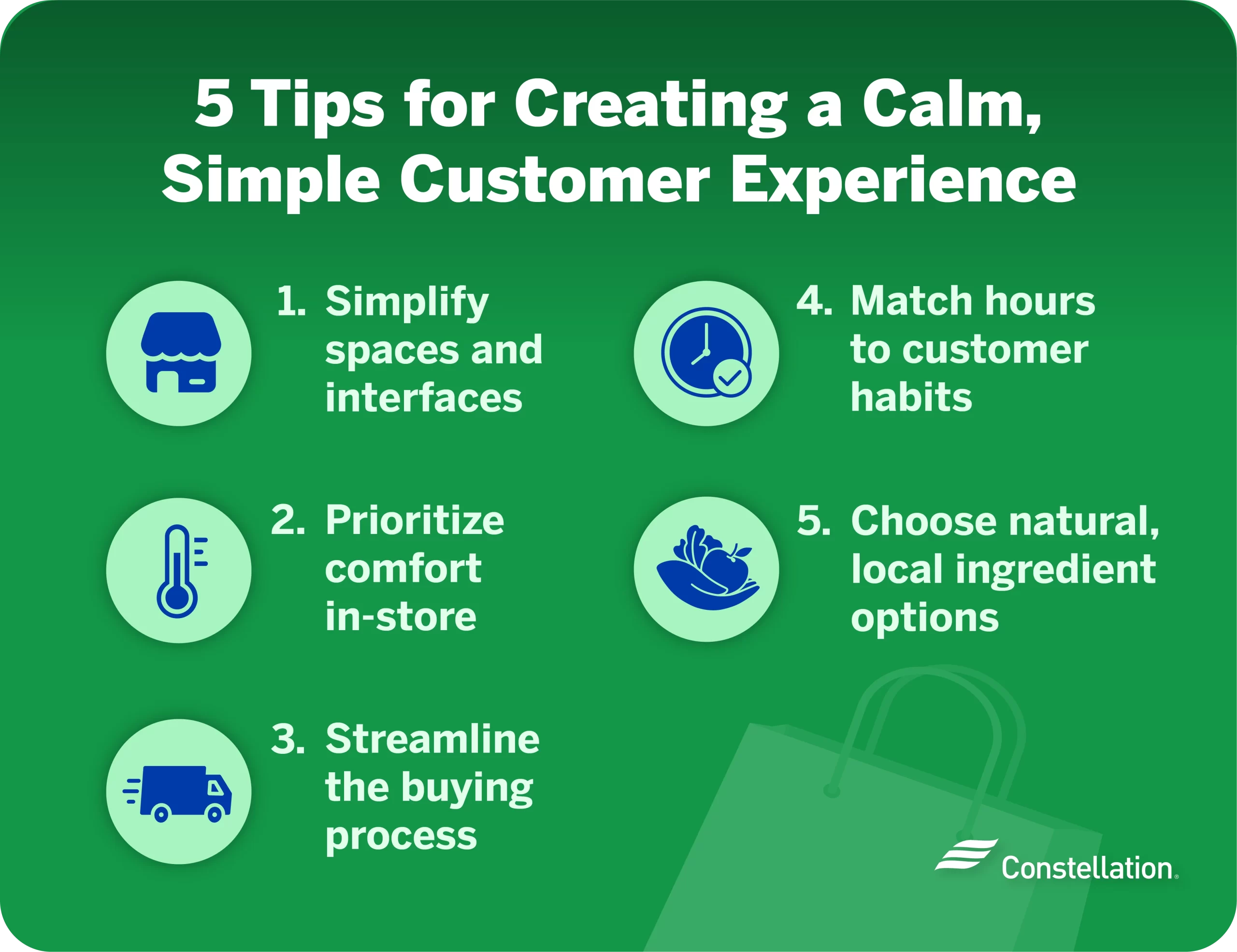
- Keep your physical and digital environments simple and calming, with intuitive layouts and familiar interfaces.
- In physical stores and restaurants, focus on optimizing temperature and airflow while setting the mood with lighting.
- Make shopping simple with easy-to-find products, lots of product details and fast delivery and returns.
- Adjust your hours based on spending patterns and customer preferences.
- Where appropriate, use natural, healthy and locally sourced ingredients.
3. The rise of AI-assisted shopping
Generative AI is a technology that’s completely changing how customers find, research, compare and choose products. If your business uses AI, consider this technology as a brand ambassador and make sure it looks, sounds and behaves in ways that enhance your reputation. Many customers already prefer AI to help with buying decisions and customer service, a trend likely to continue. That said, how your business uses AI is vital.
How to adapt:
- Make AI an option while still offering customers access to human assistance. Customers may prefer human help for complex issues.
- Be transparent about using AI so that customers know they’re dealing with a bot. Don’t imagine your AI is good enough to understand what customers are saying or to offer believable empathy.
- Realize your website and online promotions will be seen and interpreted by AI. Tailor your information, its structure and metadata to support it.
- Make sure your content works for frequently asked questions and long-tail searches, as AI-enabled search will only grow.
4. Careful spending with selective splurging
While many consumers are price-conscious and selective, that doesn’t mean they’re not willing to splurge in some cases. They may be more willing to switch to low-cost options in categories where they don’t see value.
In areas that affect their daily life and well-being or make things easier or more comfortable, spending patterns show consumers will pay more. In fact, 71% of consumers will spend more to deal with financial stress, even if they spend conservatively overall.
How to adapt:
- Control your energy costs to protect your margins, using AI to improve your business’s energy efficiency and competitiveness.
- Put increased attention on managing your inventory to ensure you have products on hand but don’t tie up too much capital.
- Consider tiered price points and value bundles so you can appeal to both budget-constrained customers and those who want to splurge.
- Adopt AI in optimizing prices, scheduling, tracking order status and communicating with customers.
5. Authenticity and consistency matter
Customers trust companies that offer genuine products, experiences and services. When your company and products are steady and dependable, you build trust and preference. Consumer behavior research points out that customers reward companies that appear genuine and consistent while engaging in their communities.
How to adapt:
- Clearly define your brand and stick with a consistent brand voice and messaging across all channels.
- Find ways to get involved with your local community that align with your corporate purpose and values.
- Make the effort to earn certifications that build trust, including becoming a certified sustainability-focused small business.
- Ask customers for feedback and respond quickly to resolve their issues.
- Back up claims with data to build credibility and trust.
Match convenience with the reassurance customers want
Consumer behavior will continue to evolve as markets shift, technologies advance and global events reshape daily life. Businesses that closely track consumer trends and spending habits and then act decisively are most likely to outperform their competitors.
By focusing on customer needs, expectations and emotions, you can respond faster, build trust through consistency and transparency and turn changing expectations into lasting loyalty.