- Category:
Small Business Energy Savings -
Last updated:
July 1, 2026
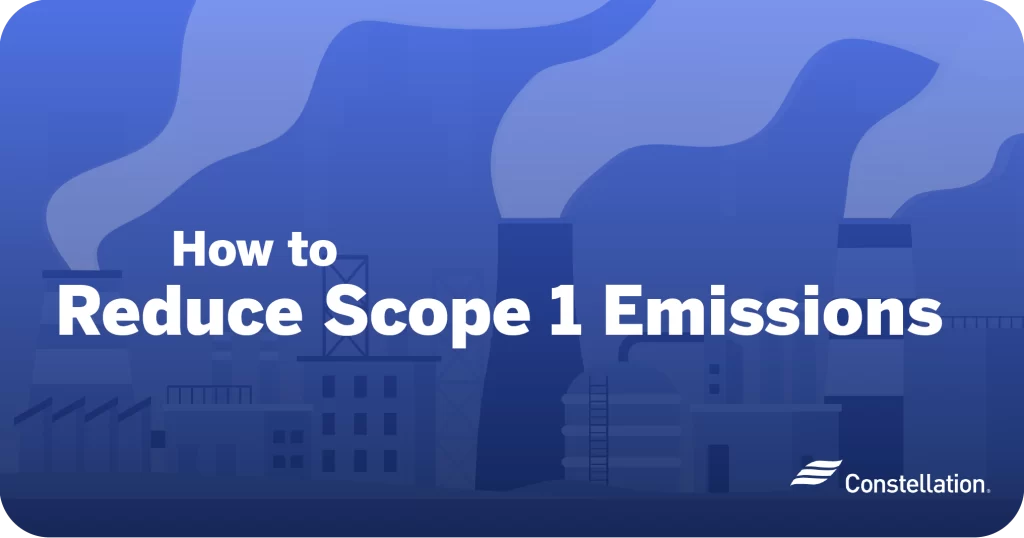
How to Reduce Scope 1 Emissions
Reducing Scope 1 Emissions, the direct greenhouse gases (GHGs) that companies release during their operations, could have a meaningful impact on your business. GHG Protocols categorize corporate emissions by their source and a company’s level of control over that source. Lower carbon emissions could improve operational efficiency, reduce energy usage and contribute to environmental regulation compliance.
Here, we’ll explain what Scope 1 Emissions are and how to calculate them, as well as provide you with actionable strategies for reducing Scope 1 Emissions in your business.
What are Scope 1 Emissions?
Scope 1 Emissions are defined under the GHG Protocols, which are standards developed by the World Resources Institute in partnership with the World Business Council for Sustainable Development. The protocols provide a framework that companies can use to account for their entire carbon footprint. GHG emission reporting falls into three categories, as defined by the World Resources Institute:
- Scope 1 Emissions: These are direct emissions from sources a company owns or controls, including vehicles and other fossil-fuel-burning equipment such as boilers, furnaces and manufacturing equipment.
- Scope 2 Emissions: These are indirect greenhouse gas emissions from the generation of purchased electricity, steam, heating or cooling consumed by the reporting organizations.
- Scope 3 Emissions: This category covers the remaining indirect sources of GHGs in a company’s value chain, including both upstream and downstream emissions such as capital goods, moving goods and supplies between suppliers and your facilities via third party carriers, business travel, employee commuting, product use and waste disposal.
Common sources of Scope 1 Emissions
Common sources of Scope 1 Emissions can vary by industry and business. For example, a manufacturing company will usually have different emissions sources than a healthcare practice or restaurant. Here are some examples of Scope 1 Emissions sources:
- Fuel used to power industrial equipment such as forklifts and machinery
- Natural gas used in on-site boilers and furnaces
- Fuel used by company-owned vehicles
- Refrigerant leaks
- Fuel used for cooking equipment
- Fuel consumed by emergency backup generators
Why reducing Scope 1 Emissions matters
Reducing Scope 1 Emissions could do more than lower your company’s environmental impact. It could also create several business benefits, including:
- Regulatory compliance: You’ll be prepared as new or revised governmental reporting and disclosure rules are introduced. Calculating your Scope 1 Emissions and tracking them regularly can help you respond quickly to changing requirements.
- Financial benefits: Controlling Scope 1 Emissions can improve energy efficiency while lowering fuel consumption and waste. Making changes that reduce your carbon footprint typically translates into financial benefits, such as lower operating expenses, reduced maintenance and longer equipment lifespans.
- Competitive advantage: Stakeholders, including customers, partners and investors, increasingly value environmental stewardship. You can strengthen your reputation and differentiate your company from competitors by demonstrating your environmental stewardship achievements.
- Reduced risk exposure: As regulations evolve and costs rise, so does the risk to your operations and budget. Understanding how to calculate Scope 1 Emissions and taking practical steps to reduce them can help improve your long-term business outlook.
Strategies for reducing Scope 1 Emissions
When it comes to reducing Scope 1 Emissions, the right strategy depends on your industry, business and the specifics of your operations. An energy-intensive manufacturing operation will have a different carbon footprint than an office-based service business.
The easiest place to start is to identify where you’re producing the greatest amount of direct emissions according to the GHG Protocols. From there, you can develop strategies that focus on areas where your efforts will have the greatest impact.
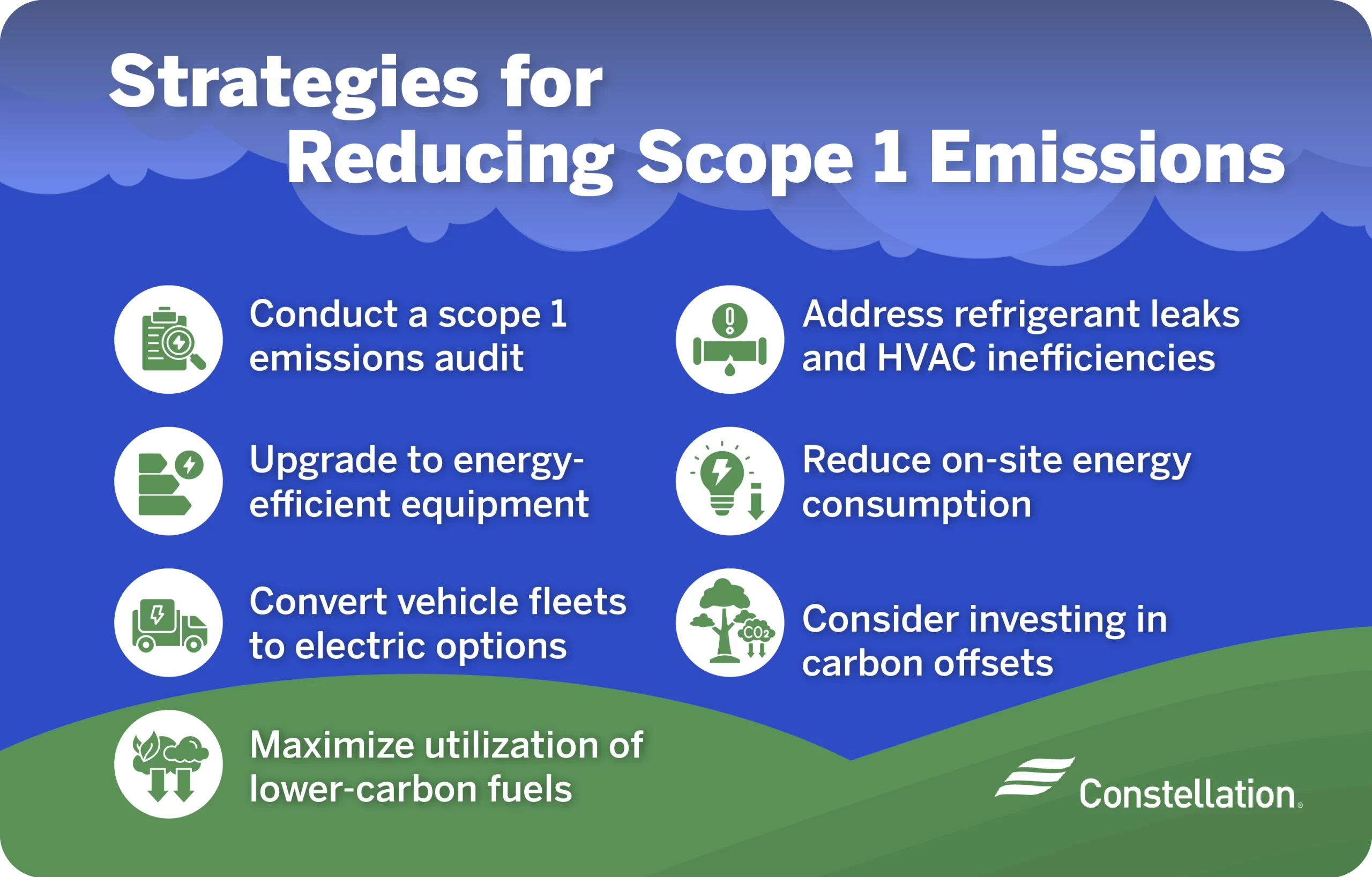
Conduct a Scope 1 Emissions audit
An effective strategy for reducing Scope 1 Emissions depends on having a solid starting point and metrics for prioritizing potential actions. Measuring Scope 1 Emissions begins with identifying and quantifying the direct emission sources. Conducting an audit gives you a picture of where your emissions are greatest. Use data from fuel purchase records, utility bills, refrigerant maintenance logs, fleet fuel usage reports and operational records to establish a measurable baseline.
You may want to combine an emissions audit with a business energy audit, as this can uncover consumption patterns and help you identify where your changes will have the greatest impact.
Upgrade to energy-efficient equipment
Older systems, such as boilers, furnaces and generators, tend to consume more fossil fuels than newer models. For many companies, these systems represent the largest share of total energy consumption and emissions. Reducing HVAC energy consumption can have a large impact on decreasing your Scope 1 Emissions, while also contributing to lowering operating and maintenance costs.
Convert vehicle fleets to electric options
If your business uses vehicles with traditional combustion engines, consider switching them out for electric vehicles. Cars, vans, trucks and service vehicles that run on gasoline or diesel can be a major source of Scope 1 Emissions. Your business may qualify for federal, state or local incentives that help with the costs of transitioning to electric vehicles and installing charging stations.
Maximize utilization of lower-carbon fuels
If it’s not possible to replace equipment and vehicles with electric options, you can still take steps to reduce your carbon footprint. Switching to low-carbon alternatives, such as natural gas, biodiesel or even hydrogen, contributes to lowering Scope 1 Emissions.
Address refrigerant leaks and HVAC inefficiencies
If your business uses refrigeration equipment, runs industrial cooling systems or has a significant HVAC system, leaking coolants may be a problem. Even small leaks can impact the environment and reduce the efficiency of your operations. Inspecting these systems regularly and keeping up-to-date with maintenance can prevent leaks or help you catch them early.
Reduce on-site energy consumption
Making process improvements and performing basic maintenance are both low-investment strategies for reducing Scope 1 Emissions. Improving insulation, sealing leaks and installing smart thermostats can reduce the load on your HVAC system year-round and help limit power usage.
Changing your operating schedules may also help to reduce equipment in idle time and improve processes for even greater efficiency. Incremental improvements typically don’t require a high upfront cost, but they can deliver ongoing carbon emissions reductions over time.
Consider investing in carbon offsets
For some businesses, reducing emissions can be difficult in the short term. When you can’t lower direct emissions, you can offset them by funding projects that remove GHGs from the environment. You can earn carbon offset credits by investing in approved projects such as reforestation programs, methane capture installations and renewable energy facilities. Offsets are a practical way to reduce short-term Scope 1 Emissions as you work toward a lower carbon footprint in the future.
Tools and resources to support Scope 1 Emission reduction
The right frameworks, measurement tools, technical guidance, and financing resources can make it easier to plan, fund, and implement your carbon reduction projects.
EPA Emission Inventory Guidance
The U.S. Environmental Protection Agency can help you better understand how to calculate Scope 1 Emissions, set up a consistent emissions inventory and document the accuracy of your reporting.
GHG Protocol Corporate Standards
The standards outlined in the GHG Protocols are the most used framework for measuring and reporting emissions. The accounting and reporting methodologies provide recognizable documentation of your Scope 1 Emissions reductions.
Federal tax credits for energy-efficient upgrades
To help balance the upfront costs of upgrading systems and making energy efficiency changes, you may qualify for federal tax incentives. You can use ENERGY STAR®’s federal tax credit resources to identify incentives that may be available for your business.
Financing options for Scope 1 Emissions reduction upgrades
Your business may qualify for targeted loans, utility programs, and Energy Savings Performance Contracts. In these contracts, the contractor guarantees a certain level of energy savings, and your business uses the financial benefits to help pay for the upgrades. It’s worth exploring the financing options available to your business.
ENERGY STAR® resources for small businesses
The ENERGY STAR® for small businesses site offers a wide array of tools, checklists, benchmarking statistics and practical advice. It can help you identify areas where you can improve energy efficiency and cut costs while reducing Scope 1 Emissions.
Take the next step toward lower Scope 1 Emissions
Translating your sustainability goals into practical action doesn’t require making several large-scale, expensive changes all at once. Instead, start with an audit to calculate your Scope 1 Emissions baseline and identify which roadmap to reduce your Scope 1 Emissions applies to your industry.
From there, you can develop a plan and budget that aims for steady improvements over time, prioritizing quick wins and less expensive changes. By learning how to measure Scope 1 Emissions and report them accurately, your business can track progress and document achievements that deliver long-term results.