- Category:
Small Business Energy Savings -
Last updated:
April 27, 2026
Workplace Occupancy Sensors: Are They Worth It?
Workplace occupancy sensors are a vital component of systems that optimize how your business uses energy. These sensors make it possible to adjust when devices, appliances and systems operate. Your systems can sense when workers are present and respond in real time rather than running on a fixed schedule.
Regular shifts and 9-to-5 work days that once made energy usage more predictable are being replaced with hybrid schedules and activity-based work. Businesses that tailor their energy usage to be as dynamic as their work patterns are more energy efficient. Benefits of workplace sensors include providing human-centered and comfortable environments, making the most efficient use of energy and creating an intelligent and adaptive workplace based on usage patterns.
What are workplace occupancy sensors and how do they work?
Understanding how occupancy sensors work is the first step in appreciating the role they play in an automated building system. The available types of occupancy sensors use different methods to determine if a person is present. They then relay that information to activate systems like heating, ventilation and air conditioning (HVAC) or fixtures like lighting. Using these systems only when needed is more energy efficient than leaving them on constantly.
Unlike motion sensors that only react to movement, occupancy sensors determine the presence of someone in a space over time. They can turn on lighting, HVAC, security and other systems and keep them running as long as people are in the room, even if the occupants are not moving around. When people leave the space, the sensor tells these fixtures and systems to turn off, saving your business energy when spaces are unoccupied.
Types of workplace occupancy sensors
With an understanding of what workplace occupancy sensors are, we can explore the types of occupancy sensors available. The right technology for your business depends on your occupancy sensor uses and room types. Many companies use several types of occupancy sensors tailored to their different spaces.
- Passive infrared (PIR) sensors: This type works by sensing body heat or, more technically, infrared radiation. It needs clear lines of sight and some intermittent movement to work, making it most ideal for private offices or restrooms.
- Ultrasonic sensors: These units send out high-frequency sound waves and measure when they bounce off objects. They work well in enclosed spaces like conference rooms.
- Dual technology sensors: Combining both of these technologies in one sensor increases accuracy. These types of occupancy sensors perform well when reliability is a priority.
- Radar/microwave sensors: This advanced technology emits and measures the bounce-back of low power microwaves. These devices detect even small movements like breathing. They work well in large spaces.
- Camera-based sensors: Cameras equipped with image processing provide highly detailed data about occupancy, space usage and movement. Camera-based sensors are a good choice when you need detailed data.
Workplace occupancy sensor uses
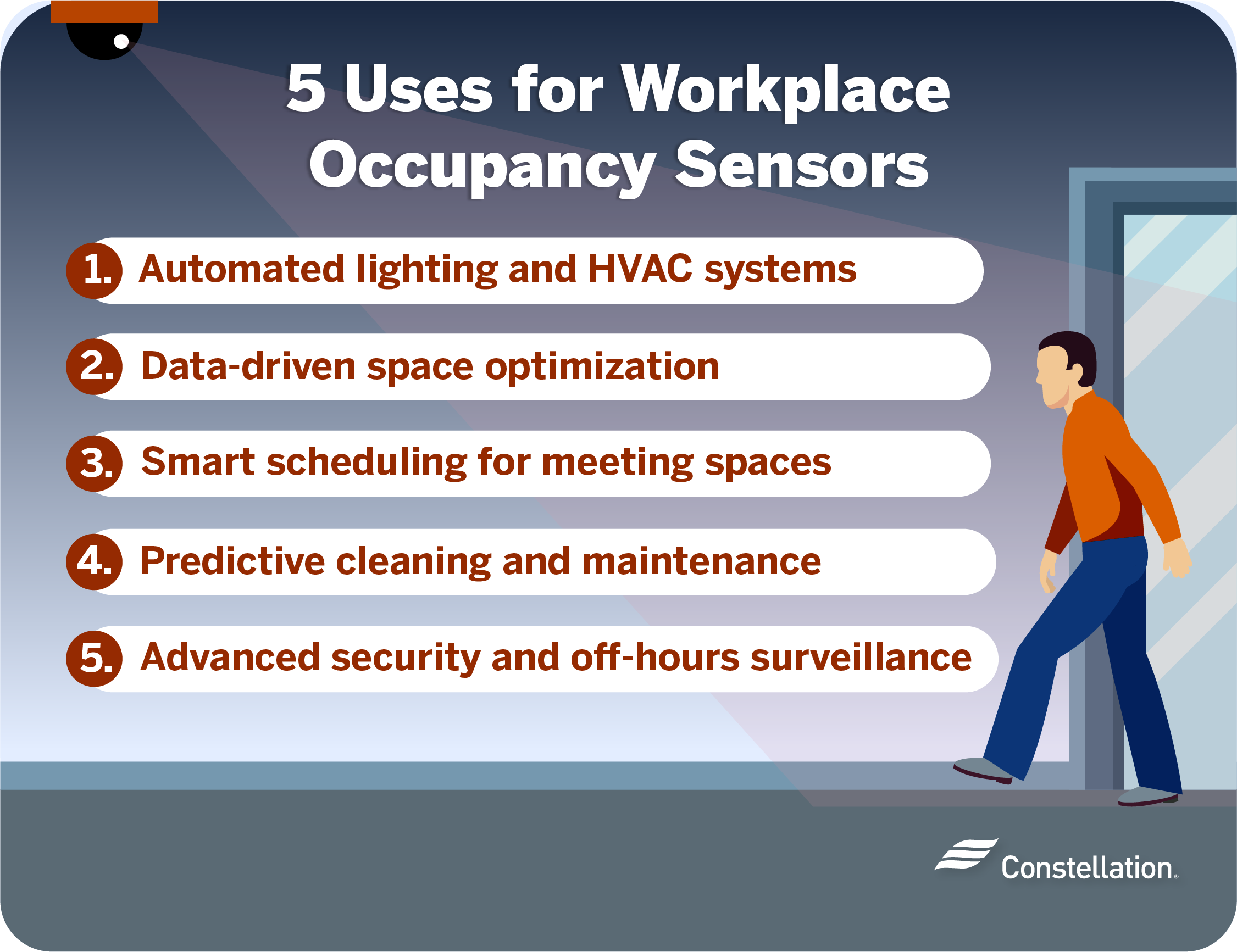
Workplace occupancy sensors have multiple uses. More than motion sensors that turn on lights, these devices create truly responsive environments, support energy efficiency and provide data that can help you optimize space, processes and security.
Smart lighting and HVAC control
Relying on employees to turn off the lights when they’re not using a space or leaving the lights on according to a fixed schedule wastes energy. The same is true with HVAC systems, which account for between 40% and 60% of energy used by many kinds of businesses. Workplace sensors help eliminate this waste. You can use the occupancy data that sensors provide to reduce lighting and office HVAC energy consumption.
Space utilization and planning
Sensors give you detailed insights into space usage across your premises. You’ll know how long people stay and can trace usage patterns over time. As your business evolves, you may find this data useful when thinking about revising space layouts, planning for more capacity and potentially investing in more real estate. You may uncover information about high-use areas that could benefit from expansion or spaces that are relatively empty that might be profitably repurposed.
Conference room and meeting space management
While energy and space efficiency are big wins, workplace occupancy sensors can make other contributions to your business. Integrate them into conference room scheduling platforms, and you may be able to manage bookings better. Release a room that has been reserved but isn’t occupied to people who need it. Make sure the HVAC starts ahead of meetings to create a comfortable environment.
Cleaning and maintenance optimization
Instead of a preplanned cleaning schedule, schedule cleaning crews based on spaces you’re actually using. Areas that haven’t been used or that are used rarely don’t need to be cleaned as often. Concentrate your resources on cleaning where it’s needed most.
Security and after-hours monitoring
Sensors that detect employees can also detect intruders. Less obvious than security cameras, occupancy sensors can alert security personnel and trigger video surveillance. Some lighting is needed for security. In areas that aren’t security sensitive, sensors can turn off lights to reduce energy consumption.
Benefits of workplace occupancy sensors
Your business can capture the full benefits of occupancy sensors by thinking beyond building automation. When you use the right workforce occupancy sensors in your business, you can increase operational efficiency, create a comfortable environment and enhance security.
- Reduced energy consumption: Using workplace occupancy sensors along with controls for lighting, HVAC and other systems reduces energy waste and contributes to a sustainable business.
- Improved workplace efficiency: Increase efficiency across operations to free facility managers for more important work.
- Data-driven insights: One of the most important occupancy sensor uses is in gathering data about traffic, space usage patterns and capacity. Data supports better decisions about processes and the allocation of resources.
- Enhanced employee experience: When light, temperature and airflow levels are adjusted to space occupancy, you create a more comfortable and productive work environment.
- Stronger safety and security: Occupancy sensors that monitor movement and activity provide an added layer of security and help you keep a closer eye on your space, even when your business is closed.
How much energy can occupancy sensors save?
The amount of energy you can save using occupancy sensors depends on your space and usage patterns. The U.S. Department of Energy estimates sensors can cut energy usage by between 10% and 90%. For example, workplace occupancy sensors can cut energy use by 29% in breakrooms, 45% in conference rooms and between 30% and 90% in restrooms. The findings show that the greatest savings potential is in rooms with unpredictable and varying rates of occupancy.
Are workplace occupancy sensors worth it?
For many companies, inefficient energy use is costly, particularly when it’s wasted in less frequently used spaces. Workplace occupancy sensors are a potential solution. Since they automate and optimize your lights, HVAC and other systems based on when they’re actually needed, they can help you cut energy usage without sacrificing comfort, safety or productivity. Knowing more about your energy usage patterns can help you plan ahead and maximize efficiency. For businesses that use a lot of electricity, the benefits can be even greater.