- Category:
Small Business Energy Savings -
Last updated:
December 15, 2025
How to Save Energy When Your Business Is Closed or Empty
How to reduce energy use when your business is temporarily closed starts with realizing just how much power you use when your company isn’t operating. Many companies close for extended periods during the holidays or seasonally, but also on weekends and overnight. You may be surprised at how much power you consume during these times.
Reducing energy use when your business is closed eliminates waste that adds to your energy bill. These weekend energy-saving tips for a small business work over the holidays and at any time your business is closed. A few small changes, such as adjusting your thermostat and shutting down idle electronics and equipment, can lower operating costs and improve the efficiency and profitability of your business.
Do empty businesses still use a lot of energy?
Yes, empty or closed businesses still use a lot of electricity. You might be surprised by how much energy your business uses after hours. When thinking about how to save energy in your office when it’s empty, consider that a quarter of a building’s energy usage happens when no one is there.
Why? HVAC systems still run to heat and cool the space. Lights are left on for security or to showcase products. Restaurants still need to refrigerate food. Electronics are often left plugged in. They consume power when “off” in a “standby” mode. This “phantom load” consumes power 24/7.

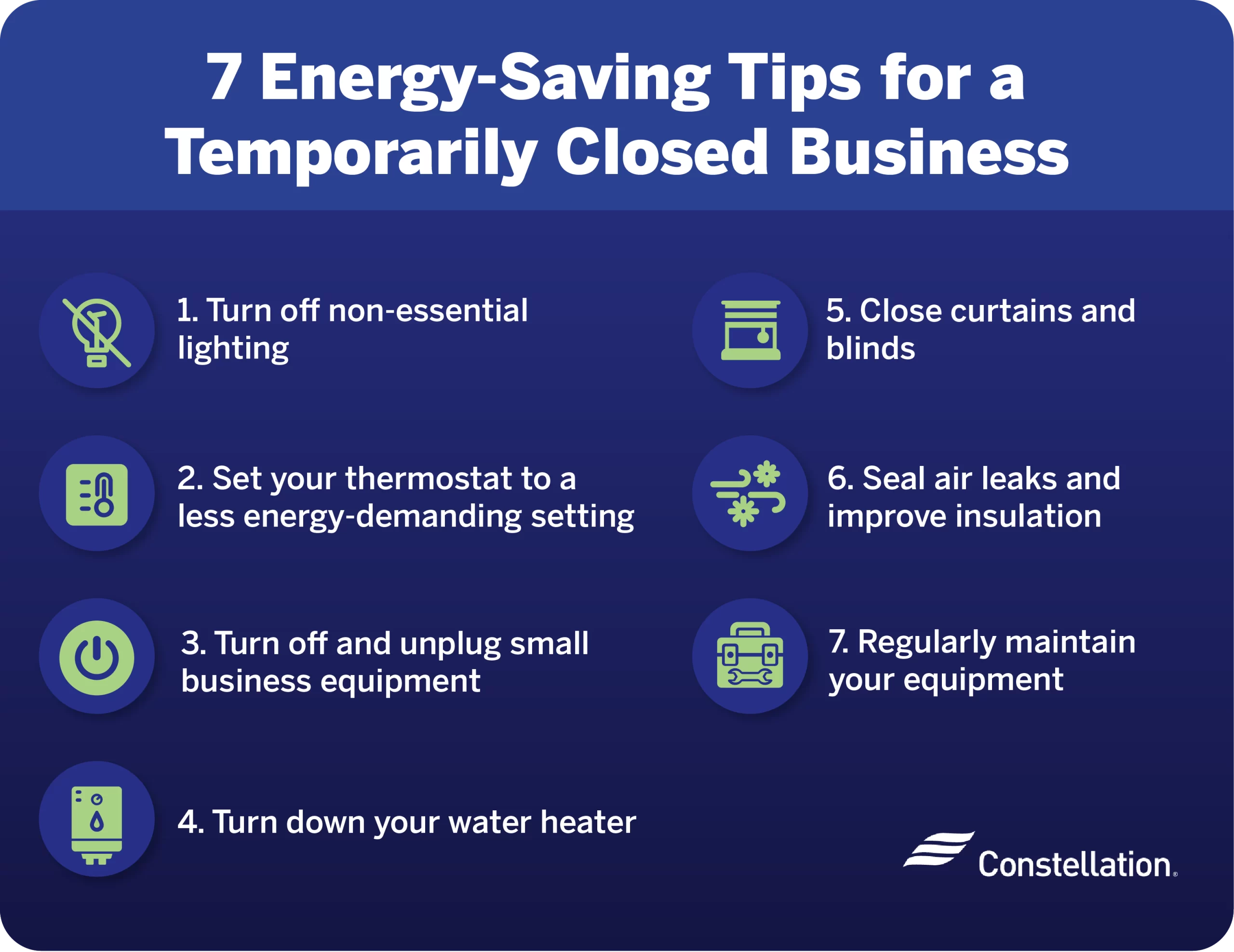
7 energy-saving tips for a temporarily closed business
Whether you need energy-saving tips for a restaurant when closed, you want to save energy in retail stores after closing, or you want to reduce empty office building power consumption, here are ways to save energy after hours.
1. Turn off non-essential lighting
Turn off the lights to reduce energy use when your business is closed. Some after-hours lighting may be necessary:
- Many retailers keep the window lights on to appeal to people passing by
- Cleaning crews and after-hours stock clerks need light to work
- Strategically placed lighting enhances security
Balance your business needs with the potential to reduce energy use after hours. Leaving the lights on is a bad habit to break for energy savings in empty office buildings. Install timers and motion sensors to turn the lights on and off automatically when no one is there. You can also put non-essential exterior lighting on timers.
Upgrading to LED lighting is another helpful tip, as LED lights use significantly less energy and have a longer lifespan than traditional CFL bulbs. LEDs can be particularly useful for saving money on required interior and exterior security fixtures.
2. Program your thermostat to a less energy-demanding setting
Reduce the load on your HVAC to cut energy use when your business is closed. Schedule thermostat settings to keep customers and employees comfortable during operating hours, then automatically reduce heating and cooling when no one is in the building. Choosing the right thermostat settings will end wasted HVAC energy usage during off hours while ensuring productivity when people are at work.
3. Turn off and unplug small business equipment
You can eliminate phantom power waste caused by devices, appliances and equipment in standby mode by unplugging them. Turning them off is not enough to stop the standby power draw.
- Offices: Turn off and unplug computers, monitors, printers, televisions, vending machines and appliances to reduce energy use in an empty office building.
- Retail stores: Unplug point-of-sale equipment and cash registers, selected display and decorative lighting, and equipment like scanners, label printers, and portable chargers.
- Restaurants: Energy-saving tips for restaurants when closed include unplugging countertop appliances like mixers, blenders and toasters. Idle dishwashers, heat lamps and beverage equipment can also be unplugged. If you have several half-full refrigerators, consolidate contents so you can unplug the empty ones.
To avoid forgetting to unplug devices, you can use smart power strips that disconnect multiple devices at once. You can program them to automate when devices are disconnected or manually control them using your phone.
4. Turn down your water heater
You don’t need hot water when your business is closed. Lower the setpoint on your water heater to a safe, but efficient level. You won’t waste your budget keeping water at an unnecessarily high temperature when no one is around.
5. Close curtains and blinds
Windows play a major role in how much heat and cold enter your workspaces. Window treatments can reduce heat transfer. Closing blinds and curtains can prevent heat loss in the winter. In the summer, closing them blocks the sun’s heat. Using window coverings is a simple, low-cost way to reduce HVAC energy use when your business is closed.
6. Seal air leaks and improve insulation
Leaks around windows, doors and utility entrances allow cool air to escape in the summer and cause chilly drafts in winter. Your HVAC will have to run longer to maintain a temperature, even when no one is in your business. Sealing these gaps can reduce energy waste around the clock. You can make your small business even more energy efficient by improving insulation in your ceilings and walls.
7. Regularly maintain your equipment
Equipment that runs smoothly uses less energy. Poorly maintained systems use more energy and are prone to problems. Routine maintenance of your HVAC system, for starters, improves efficiency and prevents breakdowns. Simple things like cleaning coils and moving parts, replacing filters and checking worn components will keep equipment in peak condition.
Plan for weekends, holidays and seasonal shutdowns
Balancing business needs with energy savings when your retail or office building is closed requires thought and adaptability. Saving energy overnight may differ from your weekend energy-saving routine, or from when you shut down your business for longer periods.
During short breaks, you might focus on shutting down lights, adjusting thermostat settings and unplugging devices and equipment. For longer business shutdowns, take more significant steps.
Creating an energy walk-through checklist and assigning specific tasks to team members will make sure you don’t miss anything before everyone leaves. Formalizing year-end energy planning and a checklist will help you and your team focus on energy efficiency that translates into business efficiency and effective budgeting for the coming year.
Empty business FAQs
Should I turn my HVAC off completely when my business is closed?
No, it’s actually less efficient to entirely shut down your HVAC system compared to adjusting your thermostat when your business is closed. If you turn off your HVAC completely, it will use more energy to bring the temperature to a comfortable level. Your interiors and equipment may be damaged by extreme temperature swings and humidity. Making modest changes to your thermostat settings reduces energy use while keeping inside conditions stable.
What should always stay on, even when my business is closed?
For security, safety and operational continuity, some essential systems and devices should not be turned off during business shutdowns. These include refrigerators, security systems, network equipment and critical servers, and safety and emergency lighting. What is essential varies by business type. Consider your facility, data and communications, inventory and equipment when planning what to shut down to reduce energy use when your business is closed.
Does shutting down business equipment every night wear it out faster?
No, shutting down business equipment nightly typically doesn’t increase wear and tear. Modern devices and equipment are designed to handle regular on-and-off cycles. Giving office equipment a rest reduces wear and energy waste and may also help extend your equipment’s lifespan.
How can I tell if my business closing checklist is saving energy?
Monitor how well your checklist is working by comparing utility bills month over month and against the same time last year, and by keeping an eye on your usage patterns. You may also benefit from using energy-monitoring tools to gain real-time insights into energy consumption in an empty office building, enabling you to make immediate changes.
Constellation also offers many small-business resources to help you manage energy usage, with energy plans that provide smarter ways to power your business efficiently.