- Category:
Small Business Energy Savings -
Last updated:
January 9, 2026
Effects of Power Outages on Businesses
The effects of power outages on businesses are immediate, but they can also have long-lasting impacts. Nearly every business operation today depends on electricity. From point-of-sale systems and smart lighting to automated inventory tools and climate controls, technology that relies on electricity plays a crucial role. When the power goes out, essential systems stop and your business can grind to a halt.
The impact of power outages on your business can be far-reaching. From being unable to serve customers to disrupting employees, workflows and machinery, the economic effects of power outages can be substantial. Understanding how outages affect different parts of your business is key to ensuring you’re prepared when they happen.
Jump to a section:
- 10 ways a power outage can affect your business
- What is the cost of power outages to small businesses?
- Which industries are most affected by power outages?
- Making sure your business is ready for a power outage
10 ways a power outage can affect your business
Even a short power outage will affect your employees, inventory, equipment and ability to interact with customers. Depending on how frequently temporary outages occur, the cost of the following issues can add up over time.
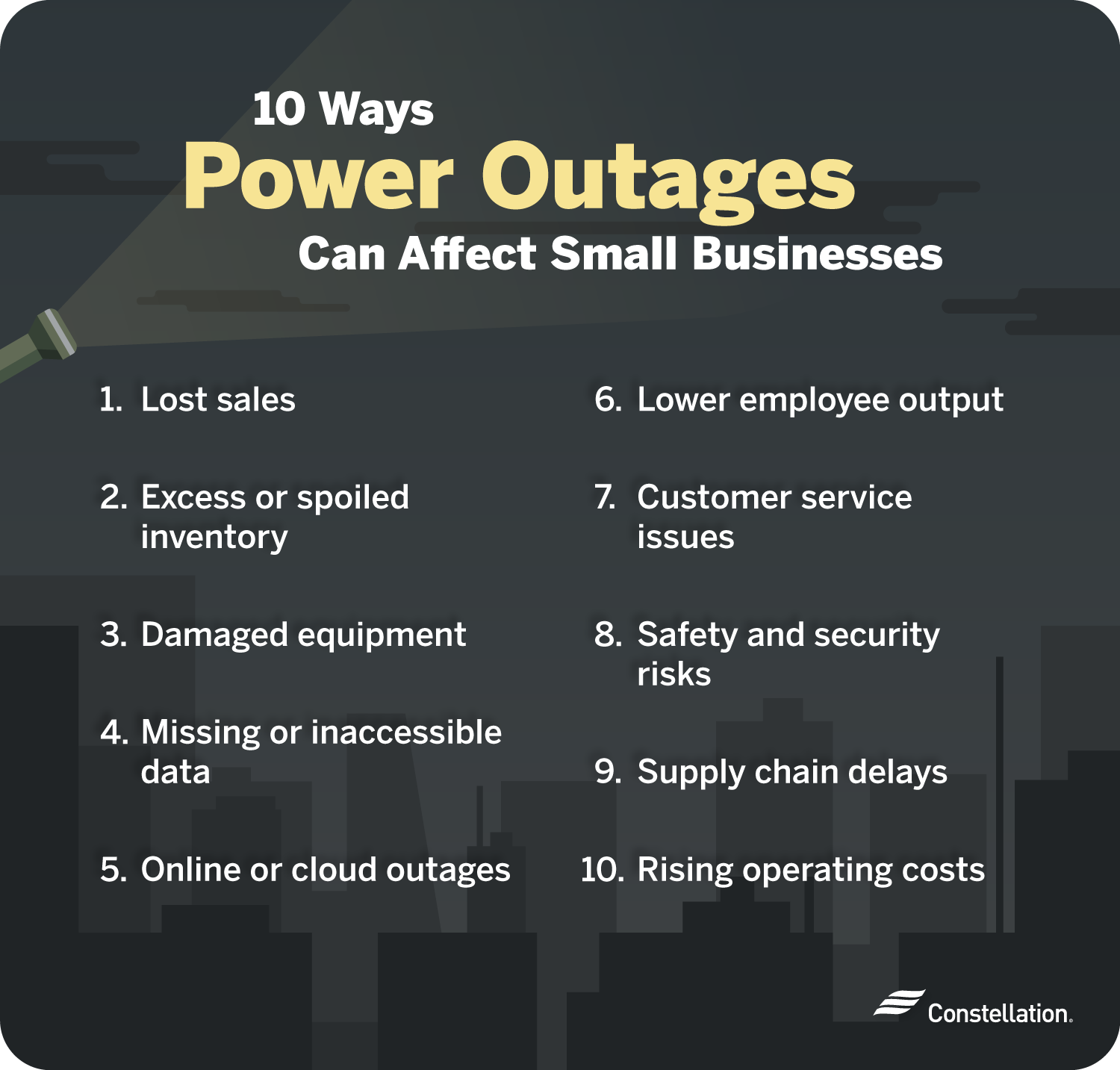
1. Missed transactions and decreased revenue
Most retail businesses use technology to link inventory control, customer loyalty tracking and additional data collection to the point of sale. This is a great practice, but it means that most retail establishments will be unable to conduct transactions during a power outage. If the outage lasts longer than a couple of minutes, customers are likely to leave without buying, and that’s lost revenue.
2. Excess, unsold or spoiled inventory
When the power goes out, operations stop and sales are interrupted. How power outages affect your business can vary depending on your industry. You may experience a drop in inventory when manufacturing stops. It’s also possible your inventory may build up, along with the costs to carry it, when no one can make a purchase.
You may have to spend time and money adjusting inventory and orders, resulting in inventory management impacts that last long after the outage. If you have perishable items, they may spoil without refrigeration. You may have to throw these items out, adding more costs to your business.
3. Damaged equipment
Even if the disruption is short, the cost of power outages is not limited to downtime. Outages can damage expensive equipment:
- Computer hard drives can be damaged if not properly shut down.
- Sensitive circuit boards can fry if still plugged in when the power surges back on.
- Interrupted processes can harm machinery mid-operation.
Surge protectors can help, but they may not prevent harm when the power returns. Backup generators take a few seconds to turn on, leaving a gap where equipment is vulnerable. Consider using uninterruptible power supplies for your most sensitive equipment to make sure important devices never fully lose power.
4. Lost business data
Most businesses today rely on the data they collect while operating for planning, forecasting and generating leads for future business. In most cases, this data is backed up automatically. But depending on how often backups occur, a sudden power outage can affect your business’s data pipeline by losing hours’, or even days’, worth of valuable data.
5. Disruptions to online and cloud-based operations
Many operations depend on cloud-based systems, magnifying the effects of power outages on businesses. Common issues include:
- Inability to access point-of-sale, scheduling, accounting or customer relationship management systems.
- Interruptions to e-commerce platforms, halting orders and customer interactions.
- Disruptions to inventory tracking and supply chain management systems.
- Failure to store, back up and synchronize data, creating the potential for errors when power and access is restored.
- Breakdown of internal communication tools such as email, messaging apps and document sharing platforms.
6. Reduced employee productivity
Whether your business is retail, manufacturing or service-based, it’s hard to imagine how employees could continue to work without power. When the power shuts down, your employees have to as well. And since they’re still on the clock in most cases, the downtime is a direct loss of revenue.
Power outages can also affect your business’s remote workers. If remote workers are collaborating with others who are experiencing an outage at their location, work for the entire group may stop, and productivity will suffer.
7. Customer service challenges
There’s never a good time for a business to experience a power outage, but there are some really bad times. If you’re having to turn customers and sales away, you’ll want to have a good customer service plan in place and perhaps offer incentives for them to return once the power is back on.
But getting customers to return may not be your biggest problem. If a customer has traveled some distance or is returning an item, a power loss can make them feel as if they’ve received poor customer service, even if your process is highly rated under normal circumstances. That can lead to negative reviews, which can tarnish your business’s reputation and lower revenue over time. Having a strong customer service focus can keep a short power loss from becoming a long-term problem.
8. Security and safety risks
A high-risk aspect of how power outages affect businesses is the increased vulnerability of your systems and facilities. When the power is out, lighting, alarms and surveillance equipment may not work. Digital systems and assets may be unprotected from cyber criminals. It’s important to plan for scenarios such as:
- Disabled security cameras, alarms and access control systems
- Poorly lit entrances, parking lots and walkways
- Malfunctioning fire detection or suppression systems
- Unsafe manual handling of equipment that’s normally operated electronically
- Weakened network defenses and monitoring tools
9. Supply chain disruptions
The effects of power outages on your business may extend to your partners, distributors and suppliers. Delays in shipments can reduce your inventory and lead to slowdowns throughout the supply chain. The cost of power outages can be magnified by:
- Delayed deliveries and cancelled orders
- Production line halts due to missing inputs
- Transportation interruptions
- Communication breakdowns as systems and connections go offline
10. Inflated operating expenses
If your business operates in an area where severe storms and power outages are frequent, you may have already set up alternative power sources. Purchasing a generator to power your business during outages may take up a significant portion of your budget. Operating your generator burns fuel and can increase your operating expenses.
Choosing the right power generator can help you balance the cost of power outages with the cost of backup power. Consider the purchase price along with the cost of maintenance and fuel.
What is the cost of power outages to small businesses?
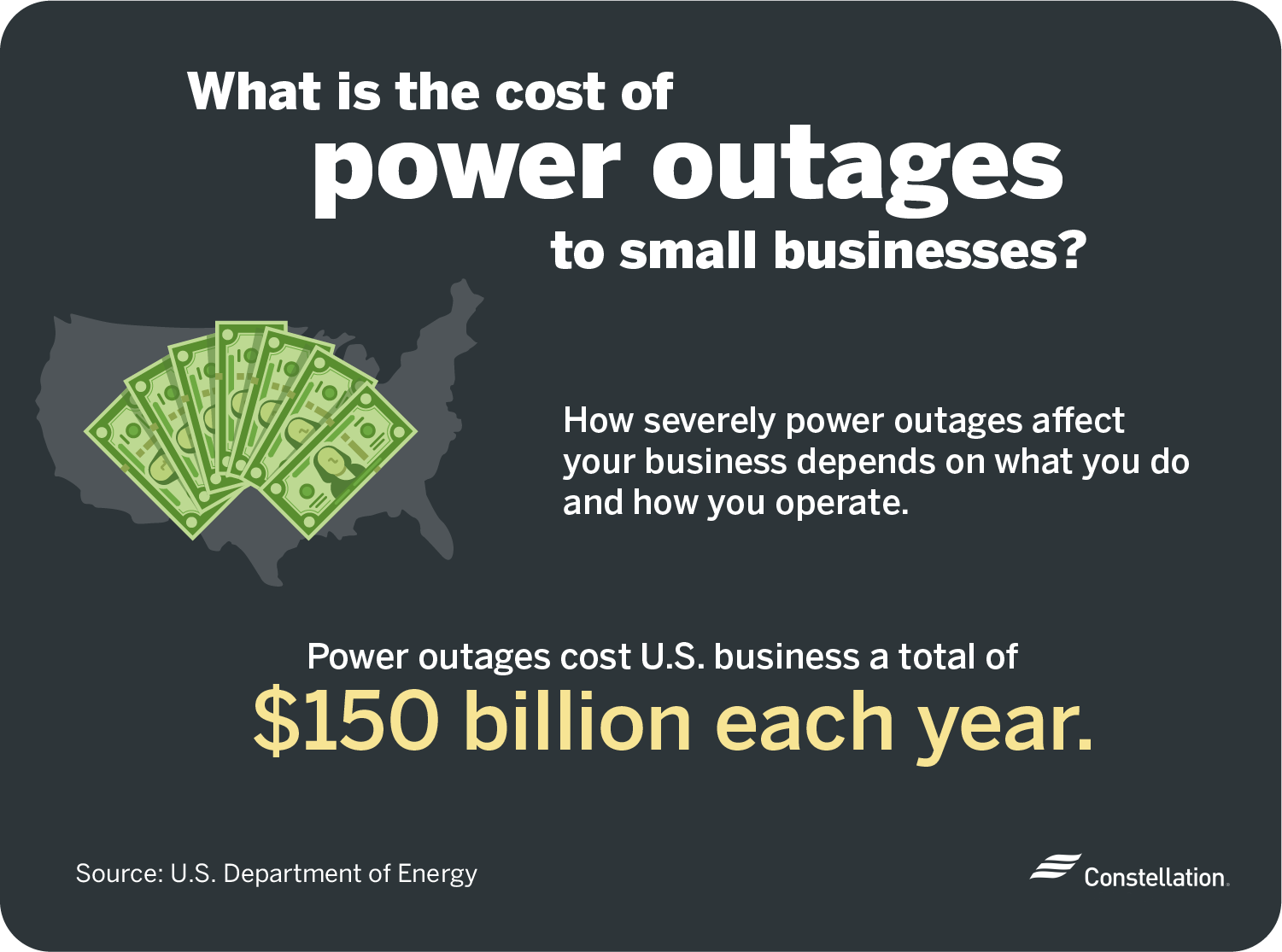
Depending on what your business does and how you operate, power outages may affect your business more or less severely than others. The U.S. Department of Energy estimates that power outages cost businesses approximately $150 billion each year.
How power outages affect the economy as a whole
If power outages are widespread or last for an extended period, they can affect many businesses at once, with the impact of power outages across large areas being costly.
Weather, including ice storms, heat waves and hurricanes, is the most common cause of unexpected interruptions in electricity service.
The impact of power outages goes beyond the immediate losses. Areas prone to electrical problems have higher insurance premiums and require paying for frequent repairs, driving up costs. Your business may also suffer from reduced customer confidence. When weather-related outages are widespread and repeated, entire areas can suffer. A 14-day outage in a major service area could reduce the gross domestic product (GDP) of the area by $15.2 billion.
Which industries are most affected by power outages?
The effects of power outages vary by industry. Businesses in every industry need electricity, but some sectors are more vulnerable than others. For some businesses, uninterrupted power is a necessity, requiring increased spending so they can continue operating during an outage.
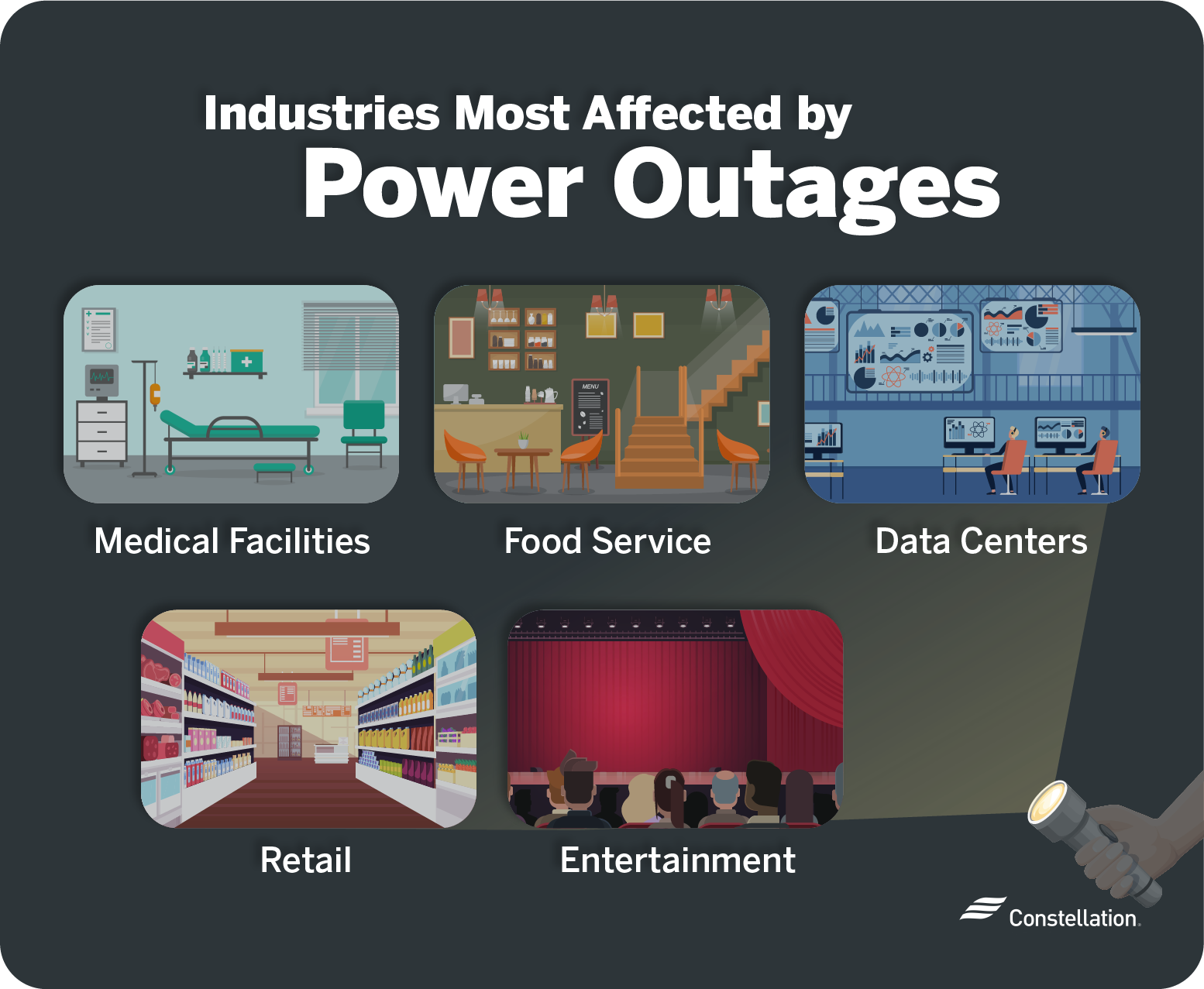
- Medical facilities. Life-saving equipment, patient monitoring and facilities support rely on electricity. Even a short power loss puts patients and equipment at risk. Such facilities must have uninterruptible power supplies to guarantee there’s no gap between when power is lost and when generators kick in.
- Food service. Restaurants need power for cooking, refrigeration, lighting and payment systems. Outages interrupt food preparation and put perishable inventory at risk. Backup power lets them continue to serve customers and safely handle food.
- Data centers. Most data centers rely on generators to keep servers running and data secure. Even with backup power, servers may not be able to accommodate all processes.
- Retail. Retail stores are highly vulnerable when power is cut. The effects of power outages on businesses like this include point-of-sale system failures, loss of lighting and increased security risks.
- Entertainment. Movie theaters and other entertainment venues need power for lighting, projection, sound and climate control. Without backup power, they have to close down, upping the cost of power outages.
Making sure your business is ready for a power outage
Power outages are unpredictable and can be costly for businesses of all types and sizes. In addition to reporting an outage, it’s important to plan ahead to limit how power outages affect businesses like yours.
The idea is to reduce downtime and improve safety. You can achieve these goals by purchasing the right small business generator and planning for what might happen to your operations in an outage.