
Making energy upgrades in leased spaces can improve operational efficiency and help your business be more sustainable. You don’t need to own the property to get these benefits. Making some simple changes in your operations and spaces, along with collaborating and negotiating with your landlord on bigger upgrades, pays off for your small business.
A variety of business types can benefit from leased business space energy improvements. Retail shops, office environments, light industrial operations, restaurants, companies in power-hungry industries and service-based businesses can achieve meaningful reductions in energy waste in leased spaces.
Why energy efficiency upgrades matter in leased spaces
Energy management for leased spaces is just as important as reducing waste in owned spaces. You and your employees can enjoy significant benefits. If your landlord is willing to work with you, you can magnify the impact of efficiency upgrades that create value during your lease term and beyond. Landlords may enjoy tax deductions, various incentives and, ultimately, increased property value.
Other benefits of energy upgrades in leased spaces include:
- Potentially lower costs: Switching to energy-efficient lights, replacing an outdated HVAC system and using ENERGY STAR equipment wherever possible may help reduce your utility expenses.
- Comfort and productivity: With better temperature control, ventilation and lighting, you create an environment that supports more productive work.
- Less downtime and lower repair costs: Maintaining modern equipment ensures smooth operations without the disruption and expense of breakdowns.
- Improvements in sustainability: Running an efficient business lowers the impact that your operations have on the environment, which is increasingly appealing to customers.
- Financial incentives: You may qualify for state and local tax rebates that can make the cost of upgrades more affordable.
- Stronger tenant-landlord relationship: By working together, you can share costs, improve lease terms and achieve mutually beneficial outcomes.
How to approach energy upgrades with your landlord
Making energy upgrades in leased spaces should start with talking to your landlord. Prepare your ideas and presentation in advance, and back up your proposal with data. Think ahead about concerns and questions your landlord may have and prepare responses. A thoughtful and prepared approach will set up a productive initial conversation and help support ongoing collaboration.
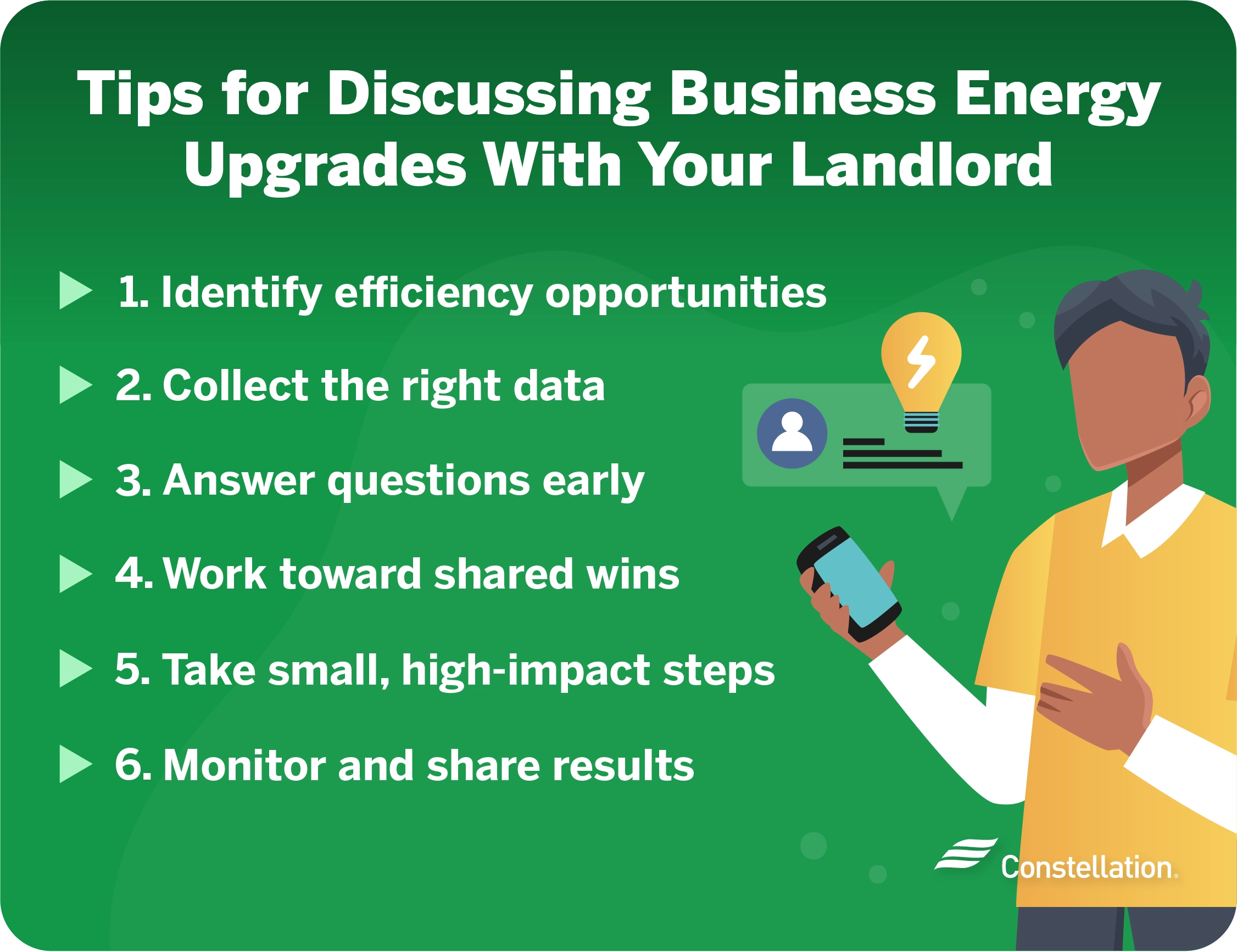

Identify key efficiency opportunities in your business
Assess your space to see where your business is consuming the most energy, and look for inefficiencies that may be increasing your costs. Since HVAC systems use the most energy at many companies, you may find that making HVAC improvements can significantly improve efficiency.
Next, take a look at appliances, office equipment and lighting. You may be able to adjust your operations and employee habits to improve efficiency. Finally, turn your attention to the building itself. Look for drafts around windows and doors, gaps that need sealing and areas where insulation is too thin.
Collect and present relevant data
When you’ve identified areas where you can be more energy efficient, document patterns, past consumption and potential energy savings. Also gather energy bills and maintenance records, and research information about incentives, rebates and tax benefits.
Having hard data about usage, costs, investment levels and potential gains sets the conversation with your landlord in concrete terms. You’ll be able to show how improvements could benefit you both and that your ideas are financially practical.
Address landlord questions early
Propose a clear and detailed plan that specifies costs, maintenance needs, time to select and manage vendors and an overall schedule. Also include an explanation of who should be responsible for which tasks.
Your landlord will likely have questions about costs vs. potential savings, the scope of effort that upgrades will require and how the business may be disrupted. Try and identify these issues and find the answers before your initial conversation. Anticipating issues establishes that you’ve thought things through in a businesslike manner.
Collaborate to achieve mutual benefits
Presenting your plan to reduce energy waste in leased spaces as a mutually beneficial partnership is more effective than simply asking your landlord to spend money on upgrades. Since both you and your landlord will benefit, it makes sense to frame the negotiation around joint efforts and shared gains.
Your landlord may be open to a green lease, which is a document that outlines how you as a tenant can work with them to align behind sustainability goals. As with any negotiation, stay flexible on timing, costs and how together you can best implement plans for leased business space energy improvements.
Start with small, impactful actions
If you sense your landlord has hesitations and concerns, start small. Look for upgrades that don’t cost too much and aren’t as disruptive. The goal is to demonstrate mutual value and show how well you can work together to achieve benefits. Getting an early win builds confidence and momentum that can support larger improvements later.
One place to start is with a small business energy audit. The result will be a clear and prioritized to-do list with expected gains for each improvement. The audit can be your shared roadmap moving forward.
Monitor results and maintain ongoing communication
Ongoing communication helps your relationship with your landlord and strengthens the foundation for working together in improving energy management for leased spaces. For every upgrade, track performance and energy usage monthly or quarterly. Seeing the impact of lower energy usage, better performing systems and fewer repair bills validates the investment you’ve both made. Tracking the metrics and sharing them with your landlord keeps you both aligned as you pursue long-term energy goals.
Tools and resources to help you implement energy upgrades in your leased space
Many tools and resources are available to help you identify, plan and pay for energy upgrades in leased spaces. In the list below, you’ll find guidance on best practices, programs that offer financial support and resources for helping you identify and prioritize projects. And for achieving environmental goals, you can explore various small business sustainability certifications.
- ENERGY STAR Small Business Resources
- Federal Tax Credits for Energy-Efficient Upgrades
- Commercial Energy Efficiency Programs by State
- Energy Efficiency Rebates for Commercial Buildings
- Financing Options for Energy Efficiency Upgrades
Putting your business’s energy upgrade plan into action
With insight into how businesses can improve energy efficiency in leased spaces, you’re ready to take steps to reduce waste and improve the overall efficiency of your business. Some changes also enhance the comfort and productivity of your staff and the reliability of your equipment and systems. Making even modest energy upgrades in leased spaces can deliver real value.
Success depends on good planning and use of resources. A good place to start is seeing what business energy savings tips you can implement easily. Just as important is finding a way to work with your landlord. When you align behind shared benefits and coordinated efforts supported by clear communication, you can make cost-effective investments with sustainable payoffs. The improvements you make together can increase the value of your landlord’s property and your business.