
Getting an early start on your 2027 financial planning can give your business a crucial competitive edge. With rising benefit costs, persistent inflation, high interest rates and the rapid shift toward AI, preparing for the unexpected is both more challenging and essential than ever.
This guide outlines practical steps to help you analyze your business’s 2026 performance, project expenses for the coming year and track spending effectively. With these insights, you’ll build the financial flexibility needed to adapt quickly and keep your business on track through 2027.
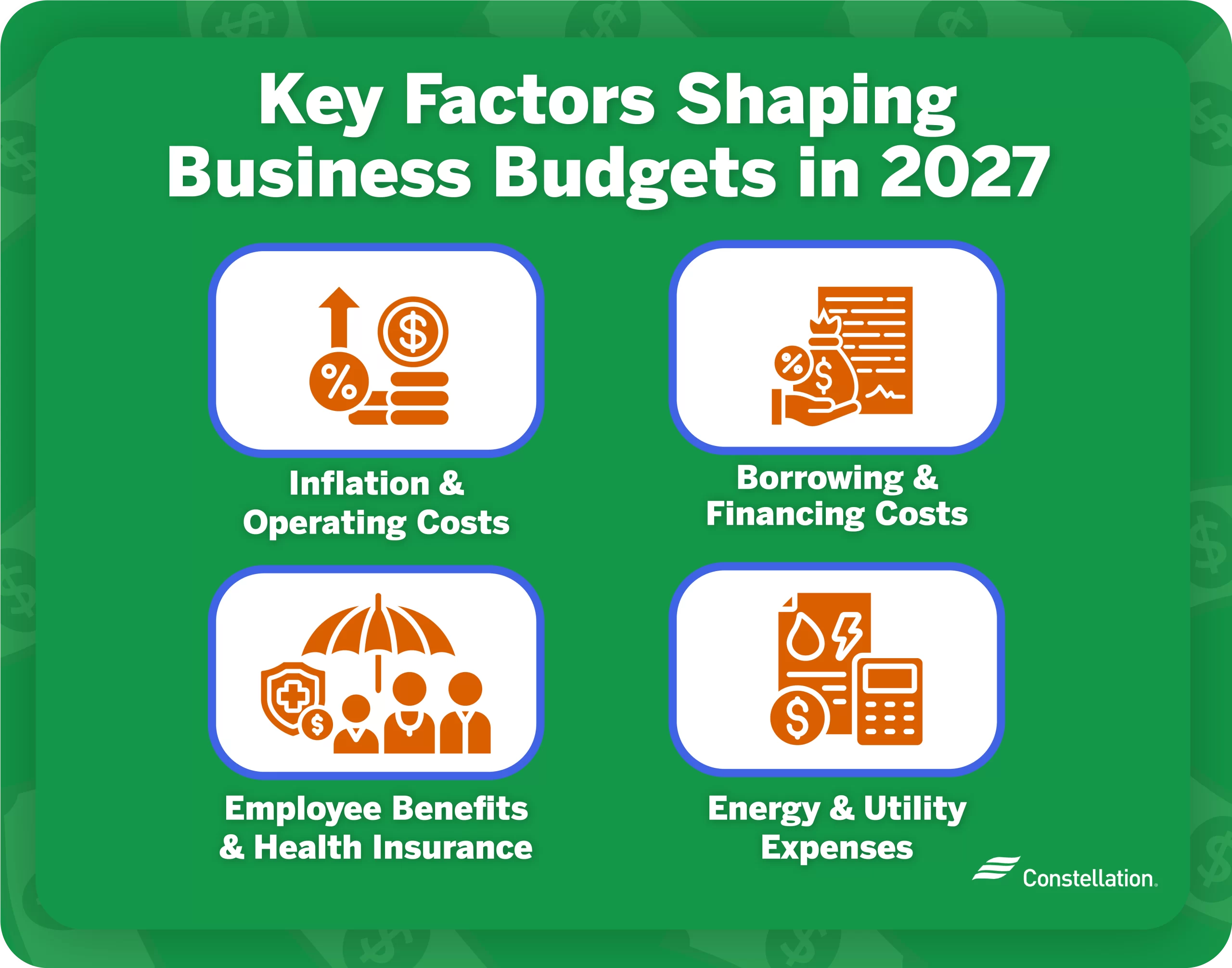
Key factors shaping business budgets in 2027
Conducting realistic business budget planning entails more than simply projecting your current finances into the next year. Consider the trends and situations that may impact income and expenditure so that you can plan for several potential scenarios.
Inflation and changing operating costs
Inflation is increasing the cost of rent, supplies, insurance, wages and other expense categories. Federal Reserve estimates released in June 2026 predict a median personal consumption expenditure inflation rate of 2.3% for 2027. While these projections are uncertain, planning for this and similar scenarios ensures you’re ready, even when the future isn’t clear.
Borrowing and financing costs
Higher interest rates mean you’ll pay more to borrow with credit cards, business loans, equipment financing, new mortgages and even inventory factoring. In addition to your business paying more, your customers will be affected by higher interest rates, too, and these higher borrowing costs may limit their spending. The overall effect is predicted to result in a somewhat restricted business climate in 2027.
Employee benefits and health insurance
Employee benefits and health coverage are major cost categories for business budgeting, following salaries and wages. The Kaiser Family Foundation, a nonprofit researching U.S. health policies and costs, predicts the average premium will increase by about 14% in 2027. However, the actual change you’ll see will depend on your insurer, type of plan and business location.
Energy and utility expenses
Many businesses count electricity, natural gas, water and other utilities as major operating expenses. The type of business you run drives these costs to some degree. For warehouses, manufacturing businesses with energy-intensive equipment, restaurants, offices and stores, energy costs can be significant. Investing in energy efficiency and making upgrades that conserve power are wise strategies for 2027.
Business financial forecasting for energy efficiency may include investments such as:
- Upgraded lighting
- Energy-efficient appliances, devices and machines
- A new heating, ventilation and air-conditioning (HVAC) system
- Tools to monitor and optimize energy usage
Follow business energy-saving tips and conduct energy budgeting to help control your business costs and keep them more consistent.

Business budgeting vs. forecasting
Annual business budgeting involves creating a financial plan for what you expect your business to earn and spend in the coming year. It’s based partly on current information and partly on the upcoming trends and needs you expect to see. Your forecast reflects what you expect will happen, while your budget is your plan in response. The two components work together.
For example, you might forecast that, based on current sales, you expect to generate $1 million in revenue, with spending at $800,000 for 2027. You might then do your business budget planning based on those numbers. Business financial forecasting isn’t a once-and-done task. As you start generating real results in the first few months of 2027, you may wish to adjust your budget up or down based on actual performance and changing expectations.
7 steps to build your 2027 business budget
A good starting point for financial planning for business in 2027 is to understand what happened in 2026. Look at past performance and the reasons behind your actual income and expenses. Make a business financial forecast for your company with these facts in mind.
Also consider the use of AI tools for small businesses. This technology is evolving quickly, allowing you to streamline tasks, uncover hard-to-find information and analyze complex data. One area where AI is especially useful is in identifying ways your business can potentially save energy and control costs.
The following business budget tips will set you up for a strong start to 2027 and help you better adapt throughout the year.
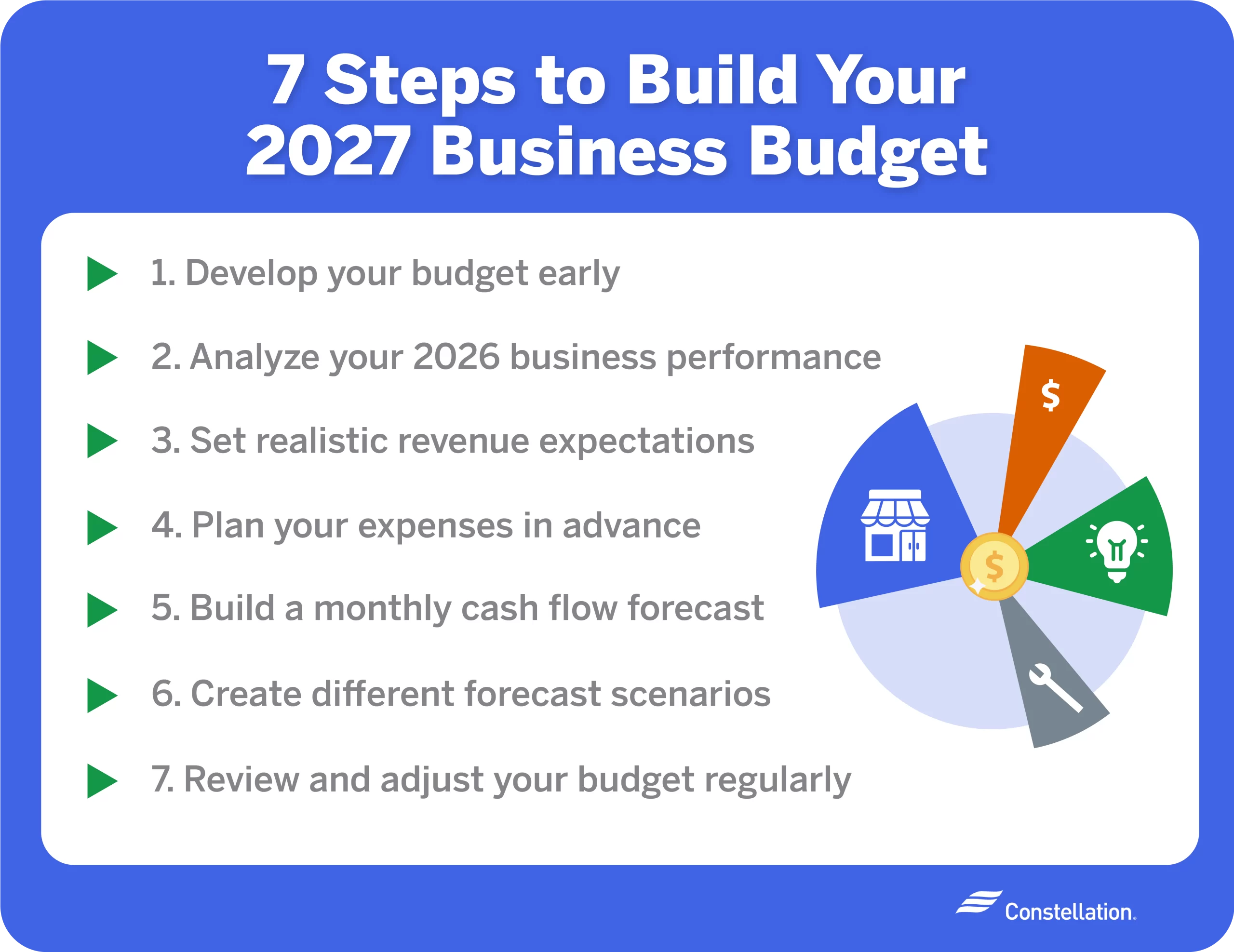
1. Develop your budget early
Start your business budgeting process early. By analyzing 2026 data now, you still have time to make adjustments before the year ends.
Examine sales and expense trends to identify challenges before they carry into next year. You might also uncover a savings or growth opportunity to capitalize on now. This can help you start the new year with more momentum and less uncertainty.
2. Analyze your 2026 business performance
Use actual results from 2026 as a starting point for your 2027 business budgeting. Review variable expense categories such as the cost of goods sold and supplies that fluctuate depending on your sales or production volume. Then assess overhead costs such as payroll, rent, utilities and insurance.
Look at your forecast to predict what might change, including things that could result in hiring more people or paying higher benefit costs. Examine the revenue projections as well, estimating where growth may come from and where you might see declines.
3. Set realistic revenue expectations
Base your revenue targets on actual past performance and your expectations on changes in the market and costs. Don’t assume your business will simply continue to grow at the same pace every year. Consider a conservative scenario based on your business financial forecast in case growth is slower than you expected or costs increase. Also, plan a more optimistic budget in case things turn out better than expected so you can quickly capitalize on positive trends.

4. Plan your expenses in advance
Unexpected costs can impact your finances and put pressure on your cash flow. The more accurately you plan your expenses, the more stable your finances will be throughout the year.
Account for recurring expenses such as salaries and wages, employee benefits, utilities, rent and software subscriptions. Then consider one-time expenses such as planned equipment upgrades or likely repairs to your building or HVAC. Divide your spending between fixed expenses that stay the same, no matter what your revenue, and variable expenses that go up and down with sales volume.
5. Build a monthly cash flow forecast
Managing cash flow (ensuring you have enough money when you need it) is an important part of business financial planning. Some businesses have steady income and expenses, while others may face high expenses during periods of low income, with substantial payments due before large revenues are expected. Instead of comparing annual revenue and annual expenses, plan on a month-by-month basis to ensure you have the cash you need to avoid a shortfall.
6. Create different forecast scenarios
Forecasts can change quickly as economic conditions shift or business circumstances evolve. To stay agile and ready for likely challenges, it makes sense to prepare for several scenarios. Create budgets for both optimistic and conservative business financial forecasts. Plan for favorable tariffs, interest rates, inflation, supply chain disruptions and energy rates as well as worst-case scenarios.
Considering these different scenarios can help you identify where your business is most vulnerable and where you can adjust your spending. It can also help you determine how much to set aside in reserves to prepare for unexpected challenges.
7. Review and adjust your budget regularly
The economy and your business are dynamic, constantly changing in ways you can’t always predict. Review your 2027 business budget regularly and update your forecasts as conditions change. Then, you can adjust your spending plans as needed, based on changes to revenue.
Set realistic goals and stay flexible in changing market conditions
Business budgeting is a process, not a one-time project. Continuously update your forecasts and plans based on performance and expectations. Keep an eye on sales, costs, changing customer behaviors and economic conditions that could affect your business.
One way to add stability to your financial planning is by choosing a fixed-rate energy plan from Constellation, which can help protect your business from sudden fluctuations in energy costs. By locking in predictable rates, you can focus more on growth and less on market uncertainty.